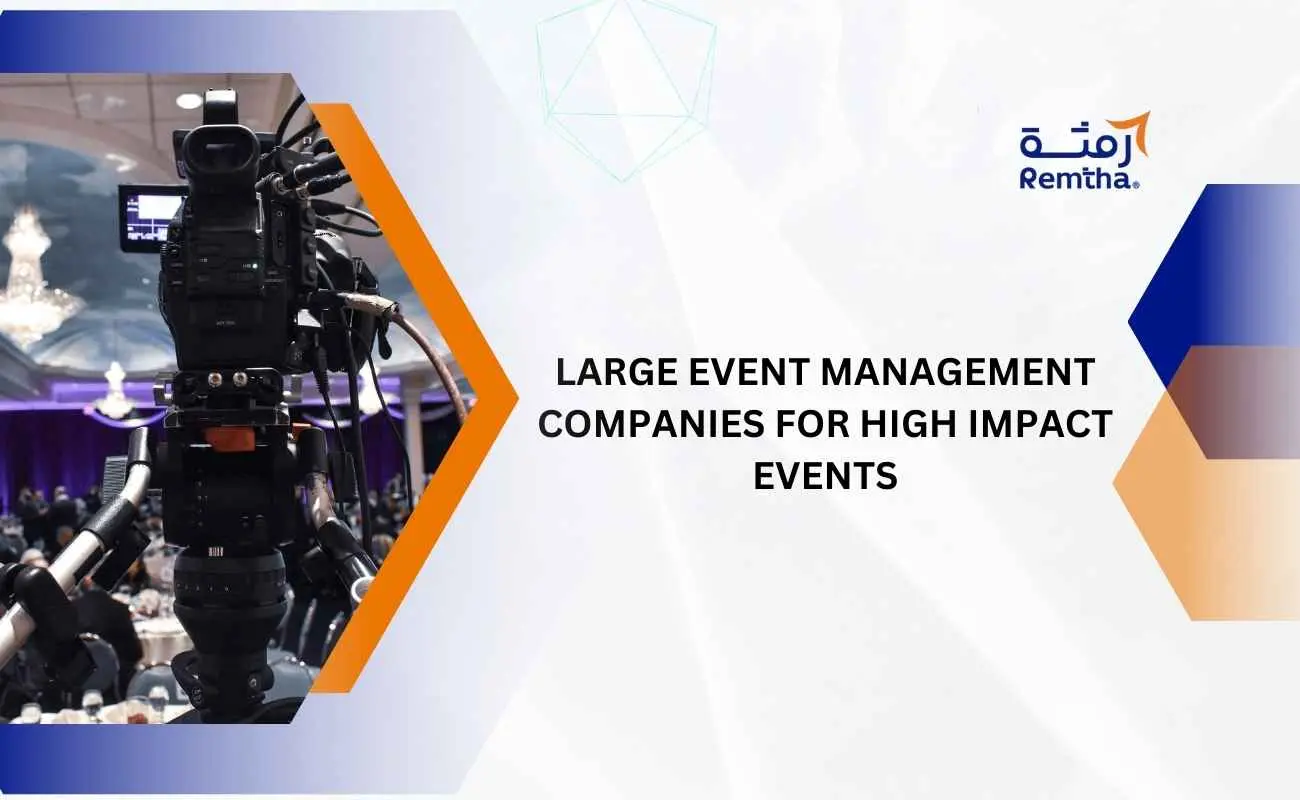
Large event management companies play a critical role in planning and delivering events that involve large audiences, complex logistics, and high operational risk. As events grow in scale, successful execution depends on structured planning, disciplined coordination, and precise control across multiple teams and suppliers. From conferences and exhibitions to festivals and public gatherings, large-scale events require experienced partners who can manage budgets, timelines, safety, and performance measurement to ensure consistent and measurable outcomes.
What Are Large Event Management Companies?
- Specialized agencies that plan and manage events with large audiences and complex operations.
- Work with corporations, governments, and institutions on high-scale events.
- Handle events that involve multiple venues, stages, or large public spaces.
- Translate event objectives into structured operational and execution plans.
- Manage extensive supplier networks and on-ground teams.
- Coordinate logistics, production, security, and crowd management.
- Ensure regulatory compliance and safety standards.
- Control timelines, budgets, and resource allocation.
- Reduce operational and reputational risks.
- Deliver reporting and performance insights through experienced large event management companies.
How to Choose the Best Large Event Management Company?
- Look for large event management companies with proven experience in similar-scale events.
- Evaluate their ability to manage complexity, not just creative execution.
- Review past projects involving large audiences or multi-day formats.
- Assess planning methodology, risk management, and contingency readiness.
- Confirm transparency in budgeting and cost control.
- Check coordination capabilities with authorities and suppliers.
- Evaluate leadership structure and on-site decision-making.
- Ensure clear communication and reporting processes.
- Verify capacity to manage safety, security, and crowd flow.
- Choose partners that prioritize control, structure, and reliability.
The Ultimate Large Event Planning Checklist:
- Define clear objectives and success criteria.
- Identify target audience size and event format.
- Select suitable dates and locations.
- Appoint experienced event management companies early.
- Develop a detailed master timeline and milestones.
- Establish a realistic budget with contingency reserves.
- Secure permits, approvals, and insurance.
- Plan production, staging, and technical requirements.
- Design crowd flow, access, and safety measures.
- Coordinate suppliers, staffing, and logistics.
- Prepare risk management and backup scenarios.
- Conduct rehearsals, technical tests, and final reviews.
- Execute live operations with a centralized command structure.
- Perform post-event evaluation and reporting.
Event Arrangement Services by Remtha in Saudi Arabia
Best Practices for Managing Large-Scale Events:
- Early and structured planning
- Starting early allows teams to build realistic timelines and reduce last-minute risks.
- Clear governance and decision structure
- Defining roles and authority prevents confusion during live execution.
- Centralized operational control
- A single command center helps coordinate teams, suppliers, and real-time decisions.
- Supplier and vendor coordination
- Clear schedules and communication reduce delays and operational conflicts.
- Strong safety and crowd management plans
- Controlled access, movement, and emergency procedures protect attendees and staff.
- Contingency and backup planning
- Preparing alternatives for technical, weather, or operational issues ensures continuity.
- Real-time communication systems
- Reliable communication enables quick response to on-ground challenges.
- Experienced on-site leadership
- Skilled field leaders support fast decision-making under pressure.
- Documentation and post-event learning
- Capturing lessons learned improves future events with support from large event management companies.

Large Event Budget Planning: Costs, Allocation & Optimization by Region:
- Identifying core cost categories
- Production, security, logistics, technology, and staffing form the main budget components.
- Regional cost variation analysis
- Costs differ by country and city based on regulations and supplier markets.
- Fixed versus variable cost allocation
- Separating fixed costs from attendance-based expenses improves control.
- Contingency budgeting
- Allocating reserves helps manage unexpected changes.
- Local supplier optimization
- Using regional vendors reduces transportation and setup costs.
- Currency and tax considerations
- Exchange rates and local taxes impact overall budget planning.
- Value-driven spending decisions
- Prioritizing attendee experience over unnecessary production.
- Cost tracking and reporting
- Continuous monitoring ensures discipline with large event management companies.
event planning ideas for business growth strategies
Large Event ROI & Success Measurement:
- Defining success metrics early
- Clear KPIs should be established before execution begins.
- Quantitative performance indicators
- Attendance, schedule adherence, and budget performance.
- Qualitative experience evaluation
- Feedback from attendees, partners, and stakeholders.
- Operational efficiency assessment
- Measuring responsiveness and issue resolution.
- Brand exposure and visibility impact
- Media coverage, reach, and audience perception.
- Comparing outcomes to objectives
- Evaluating results against initial goals.
- Post-event reporting and insights
- Structured reports guide future improvements supported by large Event Management companies.
Large Event Management by Region:
- Regulatory and compliance differences
- Permits, safety standards, and approvals vary significantly by region.
- Cultural and audience expectations
- Event flow, formality, and engagement styles must match local norms.
- Supplier market maturity
- Some regions offer advanced production capabilities, others require additional coordination.
- Cost structure variation
- Labor, logistics, and production costs differ by city and country.
- Infrastructure and venue availability
- Access to large venues, power, and transport impacts planning decisions.
- Public safety and crowd control requirements
- Regional rules influence security staffing and crowd management plans.
- Language and communication considerations
- Multilingual audiences require adapted signage, staffing, and content.
- Risk assessment by region
- Weather, political, or operational risks differ across locations.
- Local partnerships and coordination
- Experienced event management companies leverage regional networks to reduce friction.
Discover the best event organizer in the world.
Common Mistakes in Large Event Management & How to Avoid Them?
- Late planning and rushed execution
- Avoid by appointing large event management companies early.
- Underestimating crowd management needs
- Address through professional flow design and safety planning.
- Weak contingency planning
- Always prepare backup scenarios for technical and operational risks.
- Overloading the budget with low-impact elements
- Focus spending on attendee experience and operational reliability.
- Poor vendor coordination
- Centralized schedules and communication prevent delays.
- Unclear decision-making authority
- Define governance and escalation paths in advance.
- Ignoring regional constraints
- Adapt plans based on local regulations and infrastructure.
- Lack of post-event evaluation
- Document insights to improve future large-scale events.
conclusion
Large-scale events demand more than creativity, they require structure, control, and disciplined execution. Partnering with experienced large event management companies allows organizations to manage complexity, mitigate risk, and deliver consistent outcomes at scale. Remtha supports large events by transforming ambitious concepts into controlled, well-executed operations, coordinating suppliers, managing live environments, and safeguarding the attendee experience. The result is not just a successful event, but a repeatable framework for future large-scale executions.Contact Remtha today to explore our services or contact our team to start planning a seamless, high-impact event today.
Frequently Asked Questions (FAQs)
What defines a large-scale event?
Large-scale events are defined by high attendance numbers, complex logistics, multiple suppliers, and elevated safety, compliance, and operational requirements.
When should event management companies be engaged?
Event management companies should be engaged as early as possible, ideally during the initial planning, feasibility, and budgeting phase to reduce risk and control costs.
Are large event management companies necessary for corporate events?
Yes. Large event management companies become essential when audience size increases, risk exposure grows, or operational complexity exceeds in-house capabilities.
How is success measured for large events?
Success is measured through attendance quality, operational performance, budget control, safety outcomes, regulatory compliance, and stakeholder feedback.
How does Remtha support large-scale event management?
Remtha supports large-scale events through structured planning, centralized operational control, supplier coordination, and proactive risk mitigation to ensure smooth, measurable execution.